
From the World to Osaka (and Back): Tracing Japan's Curry Obsession, part 2
from Medicine to Modernity
By Sam Lozoff
August 15, 2026
Part 2. Change ripples from the konbini
Traditional Japanese cuisine stands in stark contrast to other Asian cuisines, with little to no use of chilies or dried spices. The sinus-clearing wasabi and the scant use of togarashi pepper are the closest it gets to real heat. But 1984 marked a seismic shift as the Koikeya food company introduced Karamucho, a Mexican-inspired snack of spicy bagged potato sticks [1].
Up until this point, bagged potato chips were sold in “salt” and “consomme” flavors, and never flavored with chili powder. On the heels of Karamucho, Bell Foods (now Kracie Foods) brought to market a new, spicy instant ramen dubbed Karamente.

The growing popularity of these two processed foods coincides with the rising dominance of the convenience store (konbini) in Japan’s retail landscape. Between the 1980s and the early 90s the number of convenience stores exploded: 7-Eleven, Japan’s largest convenience store chain, quadrupled their store count, going from 1040 units in 1980 to 4270 in 1990 [2]. And by 1992, the total number of convenience store units, including all chains, climbed to over 20,000 [3]. More than ever, eyeballs – and tastebuds – were focused on the konbini’s offerings.
And a linguistic development helped to cement the “spicy” category in the mainstream of Japanese food culture. The name “Karamucho” is a cheeky, bi-lingual portmanteau of the Japanese word for “spicy” (karai) and the Spanish word for “a lot” (mucho). Similarly, “Karamente”is another Castilian-Japanese mashup of karai and “-mente”, which is the equivalent of the English suffix “-ly”. So, Karamenteroughly translates to “spicily”. The meteoric rise of Karamucho and Karamente propelled a newly-coined term, “gekikara”, or “extremely spicy”, into everyday Japanese vernacular. In 1986, publishing house Jiyu Kokuminsha awarded “gekikara” the silver prize in their annual Buzz Word of the Year competition. It is a word that has stuck around ever since, and has been associated closely with curry, and cuisines of India, Southeast Asia, and China’s Szechuan province.
Though the Karamucho snack took its inspiration from the chili powders used in Mexican cuisine, the use of chilies and spice for imparting flavor and Scoville units gained a serious foothold in the Japanese culinary world thanks to these convenience store staples.But what impact did snack foods and instant ramen have on Japan’s curry culture? It was this newfound spice obsession combined with new migration patterns from South Asia emerging around the turn of the 21st century which solidified Japan’s love of curry and fueled its expansion outside of the instant, roux-based recipes popularized in the mid-20th century.
[2] セブンーイレブン、売上高、店舗数推移 https://www.sej.co.jp/company/suii.html
[3] Nipponia, A Mini History of Convenience Stores in Japan https://web-japan.org/nipponia/nipponia19/en/feature/feature03.html
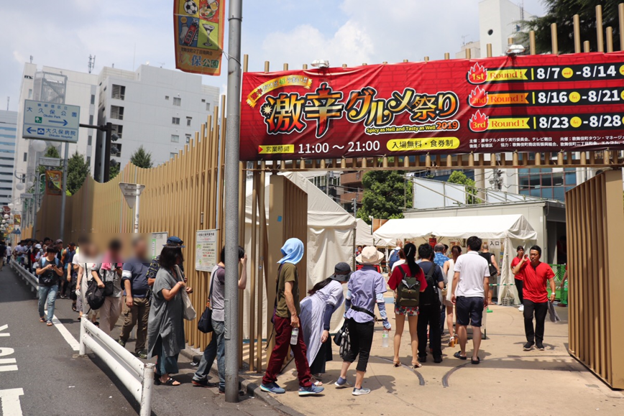
The 2019 Gekikara Gourmet Festival held in Shinjuku’s Okubo Park. The Festival was first held here in 2013 and has expanded to multiple cities including Nagoya and Hiroshima.
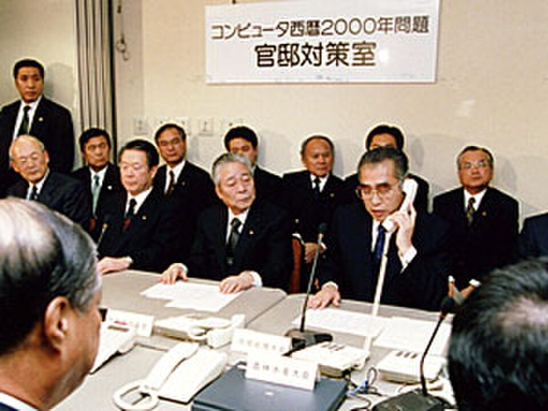
On December 29th, 1999, Prime Minister Obuchi established a specific crisis management center within his own residence to monitor potential systems failures relating to the Year 2000 (Y2K) computer problem. This photo captures the moment PM Obuchi phoned the Japanese ambassador to New Zealand in Wellington on New Years eve at 8:30pm JST to check on any potential issues “in the future”, as New Zealand had already crossed the threshold into the new millennium. [5]
[5] https://commons.wikimedia.org/wiki/File:19991231_Year_2000_Problem_Response_Office.jpg
An IT crisis fuels migration of people and cuisine
The buildup to the turn of the millennium was marked by a profound panic. The looming threat of the Year 2000 Problem, or Y2K, plagued nearly every industry and information technology department throughout the world and they scrambled to harden or debug systems against potential system-wide computational malfunctioning.
Both Japan's public and private sectors identified highly skilled tech workers from India as the solution to their Y2K problem and a general IT labor shortage. Combined with demand for skilled engineers in Japan's robust manufacturing sector, this labor shortage fueled a STEM-based immigration surge, taking the Indian population from 1,858 in 1980 to 16,988 in 2005. [4]
[4] Sawa, Munenori / Minamino, Takeshi. Emerging of An Indian Community in Tokyo: A Case Study of Nishikasai. https://web.archive.org/web/20211222044734/http://www.lib.kobe-u.ac.jp/repository/90000733.pdf
The total population of South Asians has increased six and a half times in the 20-year period between 1997 and 2017. While I won't be discussing specific migration patterns among South Asian countries or Indian regions, what I will discuss is the effect this migration had on Japan’s restaurant industry and food culture.
And the immigrant population from India – and South Asia more broadly – has continued to rise. As social scientist and linguist Rina Yamashita notes, South Asians have never been as woven into the fabric of Japanese society as they are today. “Indian restaurants managed by South Asians are in all prefectures of the country. An increase in ‘Indian IT workers’ in Tokyo has been known through the media. South Asian (mainly Nepalese and Sri Lankan) part-time workers support various industries in all prefectures where there is shortage of labor, including service industries (e.g., convenience store cashiers).” The numbers back this up [6]:

A 2017 survey by NTT Townpage showed a rapid increase in South Asian restaurants, from 569 units in 2008 to 2,162 in 2017 – a nearly four-fold jump [7]. In his book The Mystery of Curry Immigrants, author Hirokazu Murohashi states that the number of Indian restaurants boomed in the 2000s and as of 2024, the total number of units stands somewhere around 5000. [8] Yamashita writes that certain Tokyo neighborhoods like Nishi-Kasai are now affectionately known as Little India and are home to a large number of Indian restaurants that specialize in regional cuisines other than Northern Indian cuisine. She continues: “a part of Yashio city in Saitama is affectionately called ‘Yashiostan’ today, initially by Japanese people who sought ‘authentic Pakistani food”. [9] Even Shin-Okubo, known as Tokyo’s Koreatown since the mid-1990s, has evolved into a hotspot for Nepali cuisine, assuming the title “Little Kathmandu” [10].
But the growth of the South Asian immigrant population alone cannot account for the rise in popularity of its cuisine. First-hand experiences with these foreign flavors have proven revelatory for Japanese chefs and they continue to iterate and innovate. We’ll explore this in Part Three: Osaka Spice Curry, Tokyo Biryani, and Coco Ichibanya Goes to India.
[6] YAMASHITA, Rika. 2020. “South Asians in Japan: Demographic and Sociolinguistic Implications”. Asian and African Languages and Linguistics 14. P. 98
[7] インド料理店、増え続けてませんか? https://www.nikkei.com/article/DGXMZO34972090U8A900C1I10000/
[8] MUROHASHI, Hirokazu. カレー移民の謎 The Mystery of Curry Immigrants, P.11, P.53.
[9] YAMASHITA, Rika. 2020. “South Asians in Japan: Demographic and Sociolinguistic Implications”. Asian and African Languages and Linguistics 14. P. 120-121.
[10] ネパール料理激戦区「新大久保」ではしごカレー! おすすめ4店<カレー連載#151>. https://oggi.jp/7421504.
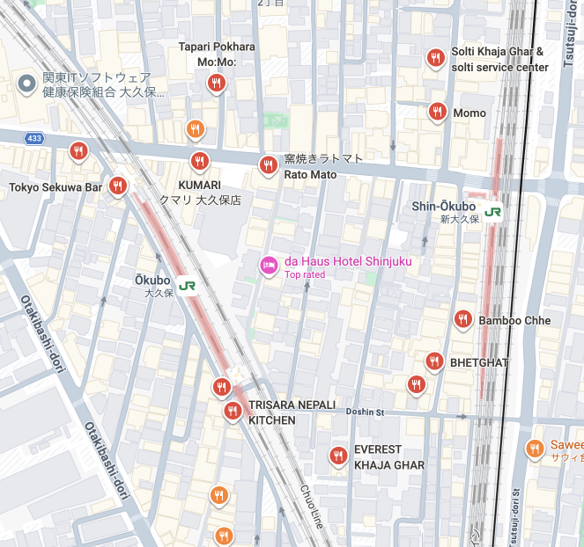
A quick search of Nepali Restaurants in Google Maps shows over a dozen restaurants in between Shin-Okubo and Okubo Stations. In any direction, it’ll take under 10 minutes to walk to any one restaurant from another. Expand the search radius only slightly and you’ll find over 20 Nepali establishments.